Orco Development
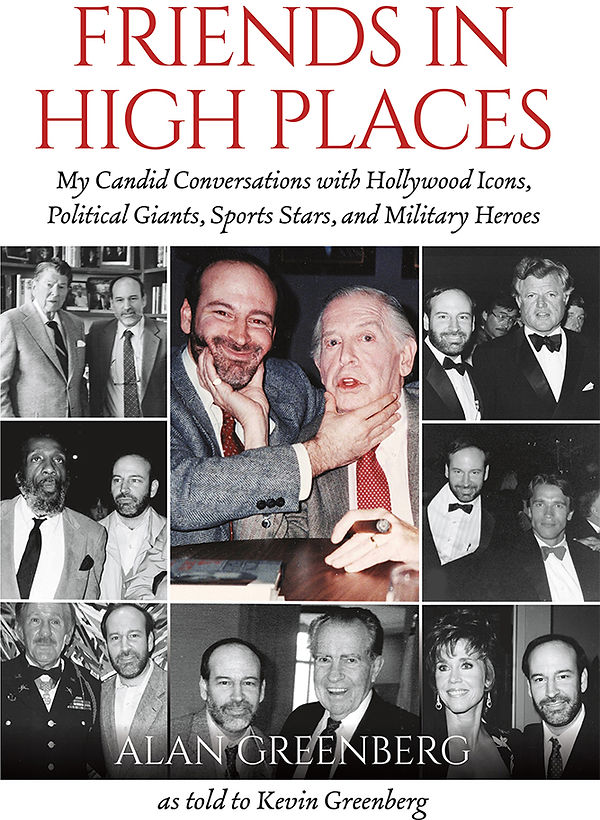
During his career as a financial adviser, Alan Greenberg started a book-reviewing newsletter called The Reviewing Stand. He would send the newsletter to his clients to keep them engaged and lease it to similar businesses throughout California. Using connections he had made with director Frank Capra, Greenberg began interviewing some of the most well-known people in their fields to discuss their autobiographies in his newsletter. This included conversations with people such as: President Richard Nixon, First Lady Nancy Reagan, Katharine Hepburn, Sidney Poitier, Coach John Wooden, and hundreds more.
An interview with author and journalist George Plimpton inspired Greenberg to take a more participatory approach to interviews. He would often ask his interviewees if he could spend the day with them, which led to adventures like: picking crops with actor Burt Lancaster, being cross examined by lawyer Melvin Belli, and getting instructed on how to swing a baseball bat by Hall of Fame hitter Ted Williams. Friends in High Places is a memoir that contains stories from close friendships and engaging interviews of Alan Greenberg over the course of his nearly forty year career.
Introduction
I was having lunch at the La Quinta Resort & Club, a beloved destination for
golfers around the country. Joining me for my meal was three-time Academy
Award winning director Frank Capra. The year was 1971, and I had decided
to write a letter to Capra after seeing he had written his autobiography, The
Name Above The Title. In my letter, I asked him if he’d like to reminisce about
his career over a meal sometime since we happened to live relatively close to
each other. Capra, who had since retired from making films, took me up on
my offer to get lunch and discuss the good old days. He had made his final
movie a decade prior, and I think he was flattered that a twenty-three-year
old man was interested in his career.
Before continuing to describe our first meeting, let me give some background
on Capra and my thoughts on why he was such a remarkable man. In
1902, he came to America from Italy at age five. Growing up in a poor Italian
immigrant neighborhood, he managed to graduate college with a degree in
chemical engineering. Now I know as much about chemical engineering as
I do about all other forms of engineering, which is to say: nothing. I imagine
that most people of Capra’s generation also knew little about it, so he must
have been an inquisitive young man to have studied it.
Yet even with his obvious intelligence, he was something of a drifter
in his mid-twenties. He wasn’t sure what to do with his life. He went from
job to job, with not much hope on the horizon, until he saw an article in a
newspaper. In San Francisco, a new movie studio was opening. Capra lived
in Los Angeles at the time. He called up the head of the studio and essentially
2
bullshitted his way into a directing job. He was extraordinarily charismatic,
which helped him immensely at this point in his life, considering he had
absolutely no film experience. His first film was called The Ballad of Fultah
Fisher’s Boarding House, based on the poem by Rudyard Kipling. A somewhat
esoteric subject for his first time directing job.
From that job, he got a gig as a comedy writer for short silent films
and partnered with a baby-faced comedic performer named Harry Langdon.
With Capra’s input as a writer, Langdon became a massive star in silent cinema,
along with Chaplin, Buster Keaton, and Harold Lloyd. If you haven’t
heard of him, there’s a reason. Langdon became arrogant and thought he no
longer needed Capra as his writer. He fired him, and his career sank like a
silent lead weight.
During the early 1930s, Capra climbed the studio ladder until he was
assigned a film project that no one else wanted to touch. It seemed dull: a
wealthy heiress and a reporter traveling across the country in a bus and
staying in a motel. In fact, the lead actress Claudette Colbert said she would
only do it for double her usual salary. The lead actor Clark Gable only did it
as punishment for angering a studio boss. The film was called It Happened
One Night, which earned five Academy Awards and made everyone involved
a superstar. Over the next decade, Capra made one hit film after the other
and was arguably the most successful director of the 1930s and early 1940s.
Back to our first meeting. Halfway through our discussion, Capra
paused and said, “you seem to know more about me than I do. What’s your
background?” I told him about my degree in Real Estate & Finance, but he
was shocked to discover that I had no formal education in film history. He
was flattered that I knew so much about him out of pure interest in his career.
That lunch began a two-year mentorship in which I would visit him at his
home, watch his films, and have him explain to me why he’d made specific
directorial choices and the business of movie-making in general.
He had in me a student with an insatiable curiosity. We watched all of
his movies on a film projector. In my opinion, and in those of other directors
3
I’ve spoken to, this was the most insightful film class they had ever heard of.
The irony is I don’t have a creative bone in my body; given a chance to make a
film with all this imparted wisdom, I would flounder. Yet I still cherish those
two years as we became great friends.
As you might imagine, a man of Capra’s status had a lot of famous
friends, not just from Hollywood but many different fields like politics, the
military, and sports to name a few. Given how close we had become, he had no
hesitation introducing me to many of those friends including Jimmy Stewart,
Katharine Hepburn, and General Jimmy Doolittle. The relationships I formed
with them were not unlike the one I had with Capra. These were people who
were legends in their profession, but their heyday had been decades earlier,
some dating back to the 1920s. They were retired and felt appreciated by a
young man eager to listen to them and discuss their glory days. Over the
years the relationships I formed with other prestigious figures like Dr. Jonas
Salk, Secretary of State Dean Rusk, and Jack Lemmon helped me develop
this network of people even further.
These relationships would become invaluable to me as years later I
would start a book reviewing newsletter with the assistance of my friend
Professor Jerry Lennington. As a result, I interviewed many celebrated individuals
who had written their autobiographies. I had many unique experiences
like visiting Mexican farm workers with Burt Lancaster, getting cross
examined by the famous lawyer Melvin Belli, and getting taught how to swing
a baseball bat by Ted Williams. I’ll always be grateful to Capra for getting me
started on this journey. We remained friends until his death in 1991.What
follows are recollections of some of the more intriguing and meaningful
interactions I had with many celebrated individuals from many fascinating
walks of life, as described to my son, Kevin Greenberg.
Chapter 11: Boys Love Their Toys
If you become friends with director Frank Capra, chances are you’re going
to meet Jimmy Stewart along the way. They were best of friends and had
worked together on films made in the 1930s and 40s that modern audiences
watch to this day, including It’s A Wonderful Life, Mr. Smith Goes to
Washington, and It Happened One Night. As close as the two men were,
though, it couldn’t compare to how close Stewart was to his wife, Gloria. I
witnessed this firsthand when I visited the happy couple in 1980.
At that time, the VCR was still a new technology. Although I was usually
frustrated by learning to operate new devices, I made an exception based
on the potential to watch classic movies and TV shows at home whenever I
wanted. One of the first shows I wanted to record regularly were reruns of The
Jack Benny Show. Since I was a kid, Jack Benny had been my idol, a comedic
radio host and actor. The Stewarts also loved this performer and were good
friends with him until his passing in 1974. They were such good friends that
Gloria Stewart, who had little to no interest in being an actress, performed
on the show several times with her husband, Jimmy.
I called the Stewart residence to set up an interview and, at one point,
mentioned I had taped several episodes of The Jack Benny Show featuring the
Stewarts. Gloria was thrilled and asked me to bring my VCR when I visited.
Of course, I agreed and, as I hung up the phone, realized I needed to race
to an electronics store to have someone show me how to hook a VCR up to
55
other people’s TV sets. However, my Luddite tendencies would not hold me
back this time.
I arrived at the Stewart home and was greeted by Gloria. She welcomed
me in and mentioned that Jimmy was busy working on a project but should
be out soon. In the meantime, she asked me to put on the show, eager to relive
some fond memories. We watched the Jack Benny episodes together, and
Gloria was delighted. “Oh, I remember that; I could barely keep a straight
face!” she exclaimed between laughs. An hour into the viewing, I excused
myself to use the restroom.
As I walked down the hall, I noticed a room with its door slightly ajar.
The light was on, and I could hear very slight movements and the distinct
odor of glue emanating from inside. I knew people were there but didn’t want
to disturb them if they were busy doing something important. So I moved
on, used the restroom, and returned to Gloria. A half-hour later, I began to
wonder what Mr. Stewart was up to. Gloria left to get Jimmy and asked me
to put another cassette tape on. She returned with two men: Jimmy Stewart
and Henry Fonda.
What the hell did they do for an hour and a half? I didn’t hear anyone
talking. I was thrilled to meet another screen icon, especially so unexpectedly.
Jimmy introduced me as “Frank’s boy” and said I was there for an interview.
We all spoke for a bit, and I couldn’t help myself. “Fellas, just out of curiosity,
what were you working on while Gloria and I watched the TV?” They smiled,
happy to show me what they had been up to. We all entered the room I had
passed by, and it was filled with model airplanes, designs for model airplanes,
and supplies for assembling them. Suddenly the smell of glue made sense.
Stewart and Fonda were close friends, and their favorite activity was to quietly
build model airplanes together as they had in their youth.
We returned to the living room and continued to watch Jack Benny.
Jimmy was as nostalgic for those days as his wife had been. Eventually, Fonda
mentioned he had to leave. I hadn’t said much to him as I felt it wasn’t my
place to start a conversation with someone of his stature after we had just
56
met. But, before he started to go, Jimmy said, “Henry, he’s interested in the
old days. Why don’t you tell him about your best review?” Fonda was happy
to oblige, and I was eager to listen.
He told me, “I would not have become a star without Marlon Brando’s
mother.” Not sure where this was going, I replied, “OK.” He continued, “Mrs.
Brando was involved in community theater and was a friend of my mother.
She got me into acting by suggesting I try out for a role in a play called You
and I. I got the part though I didn’t think much of my performance. I was still
trying to make my way as a young actor when I got the lead in a play called
Merton of the Movies. My family didn’t have much faith that I’d make it as
an actor back then, but they came to see me nonetheless. When we all got
home, they told me what they thought. My sisters were a little harsh. Said I
started off good enough but dipped in the second half. My mother thought I
was acceptable. My father listened to this and told them to shut up and that
I did a great job. I left the room when I heard that so they wouldn’t see me
cry. That was my favorite review.”
After a few more pleasant exchanges, Fonda excused himself and left.
The Jack Benny marathon was over, and the interview began. I had always
been curious about Jimmy’s service during WWII. Jimmy had gone out of
his way not to receive special treatment and flew several bombing missions
in Europe, eventually attaining the rank of Brigadier General. He had consistently
downplayed it, as modest as many of his characters on screen. I
asked him about it.
“When we dropped bombs, there were several times where I could
actually see the destruction. The buildings just exploding into clouds of
dust. It really changed me. When I got back home, I thought to myself, What
a stupid profession I’m in. Why am I spending all this time pretending when
people’s lives are being turned upside down? I thought I might get out of acting.
Frank gave me a call and said there was a picture he thought would be right
for me. I asked him what it was about, and he said, ‘You’re a banker, things
go wrong, you want to commit suicide. Then your guardian angel appears
57
and wants to help you so he can get his wings.’ I thought he was nuts. But I
said yes because everything else we did turned out great. I got on the set, and
Lionel Barrymore was there. And I start to get that feeling again; this acting
business is all a bunch of nonsense. Europe was in pieces, and I’m talking to
an angel named Clarence. So after hearing me complain, Frank said, ‘If you
really don’t want to do this, I can get someone else – no hard feelings.’
“Lionel Barrymore caught wind of this and explained something to
me. He said, ‘I understand how you feel, but you’re insulting my profession.
What you did in Europe was necessary, and it’s horrible that so many people
had to die – but that’s over now. People need relief. And I think we provide
some of that relief. Flying planes is important, but so is this – so if you don’t
want to participate, that’s fine, but I’d appreciate it if you’d leave the set so
someone without that attitude can do their job.’”That really gave me a new
perspective. If someone as experienced as Lionel Barrymore wasn’t jaded
after all those years, then I shouldn’t be either. So I became very enthusiastic
about acting again, and that negative view left my mind.” It was ironic: The
greedy and cynical banker from It’s A Wonderful Life was the one who saved
a cynical George Bailey in real life. Jimmy was thankful he had more than
one guardian angel in his life.
This interview began a friendship that lasted until his death.
Occasionally, I would stop by Jimmy’s office in Beverly Hills. During my
first visit, I noticed several columns of boxes behind the actor’s desk, stacked
nearly to the ceiling. I assumed Jimmy must be in the process of remodeling
his office. “Jimmy, is that new office furniture?”He looked up from some
papers he was reviewing. “Oh, that? No, those are fan letters asking for
an autograph.”
I looked at the boxes again. “There must be thousands of requests in
there.” Jimmy nodded matter-of-factly. I wondered what the plan was. He
thought the answer fairly obvious:” Sign them and send them back.” Again, I
looked at the boxes. “It’ll take you years to get through all that. I know some
58
politicians use an auto-pen [a machine that reproduces signatures]; ever
thought of using that?”
Jimmy put down the papers he was reading and leaned forward, staring
directly into my eyes. “Al, you’ve been to my house. Is it nice?” I nodded.
“Do you know who paid for that house?” I started to think I was treading on
sensitive territory. Jimmy pointed behind himself. “The names in those boxes
paid for my house, paid for my vacations, and paid my bills. Why should I
send them something phony? I know other people do it. But if I can’t show
my appreciation, I’m in the wrong business.” I left the office that day with a
renewed sense of admiration for this man, but this time it wasn’t for his acting
ability; it was for his character.